
Empathy – too little, too much?
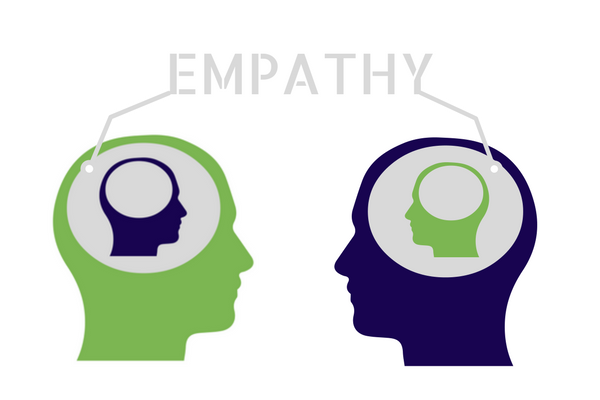
noun: empathy
- The ability to sense other people’s emotions, coupled with the ability to imagine what someone else might be thinking or feeling.
Empathy is important to healthy relationships. It’s our brain’s way of putting ourselves into someone else’s shoes. To step aside from our own feelings for a moment and realize what the other person might be going through. It’s an unselfish emotion that makes us better people, better friends.
As with any emotion, too little or too much can be detrimental not only to those around you but also to your own well-being. I’ve seen both sides of that spectrum.
I lived with a person with a total lack of empathy. It was a painful experience. As a child, I had no concept of the word “empathy.” I only knew that something was lacking in my mother. Something was very wrong. My father sensed it. I sensed it. Her friends and family were often quite aware of her inability to be understanding and compassionate.
It really hit home for me for the first time when I was about eight. I was sitting on our living room sofa, watching a WWII drama with my father. He had endured that war as a combat engineer for two and a half years, trudging through Italy, France, and Germany. I had heard his stories first-hand. Had witnessed him having nightmares. What he experienced were things you could never leave behind.
Now, next to him, I could feel his body tense. Watch his muscles twitch. See his demeanor change. Even as a being of only ninety-six months, I realized that within this man there were ghosts that would always haunt him. My heart ached for him. Then those words were hurled across the room.
“Oh, get over it. The war ended a long time ago,” she callously shouted.
Those words struck me to my bones. I can still hear them in my head, and they sicken me each time they’re recalled. How could anyone be that damned heartless? My poor father. It was so cruel. I want to cry as I tap the letters on my keyboard.
That day was a wake-up call for me, as I slowly put two and two together. But soon enough, that lack of empathy would devour my soul, as I became a victim of a person who suffered empathy-deficit disorder. The cold, dismissive, or uncaring traits of psychopathy and narcissism.
I could write a book about how disruptive it was to my life. However, I’m here today to discuss both sides of the spectrum. I ask, can you have too much empathy? The answer I give you, as well as those from the world of psychiatry, is a resounding yes.
“It’s as if you’re a sponge that is completely saturated and has never been wrung out. You can only take so much.” – from Trauma Stewardship
It’s called hyper-empathy.
Hypersensitivity to others (sometimes called heightened empathic ability or empathic sensitivity) refers to a condition in which individuals experience an intensified empathic response relative to the general population. This phenomenon is increasingly acknowledged by mental health professionals as a genuine experience that can significantly impact daily functioning.
People with hyper empathy don’t just understand others’ emotions—they absorb them, often feeling these emotions as intensely as if they were their own.
This heightened sensitivity can be both a gift and a burden, allowing for deep interpersonal connections while potentially leading to emotional exhaustion and burnout.
According to Arbor Wellness
Emotional Symptoms
- Experiencing others’ emotions as if they were your own
- Feeling overwhelmed in crowds or public spaces due to emotional overload
- Difficulty distinguishing between your emotions and those of others
- Emotional exhaustion after social interactions
- Taking on others’ problems as personal burdens
Physical Symptoms
- Physiological reactions to others’ pain or distress (increased heart rate, sweating)
- Physical sensations mirroring what others experience (feeling pain when witnessing injury)
- Fatigue and energy depletion after emotionally charged situations
- Sleep disturbances related to emotional processing
- Tension headaches or muscle tension from emotional stress
Behavioral Symptoms
- Avoidance of emotionally intense situations or media (news, dramatic films)
- Excessive care-giving to the point of self-neglect
- Difficulty setting and maintaining boundaries
- People-pleasing behaviors stemming from heightened awareness of others’ needs
- Withdrawal from social situations as a protective measure
I see this in several people I know who can’t disengage from the bombardment of the 24-hour news cycle. I only see it worsening in the world we live in. There has to be a happy medium between hiding your head in the sand and not giving a damn or dangerously immersing yourself in the lives of 8.2 billion homo sapiens.
During a recent discussion, my friend asked, “Well, don’t you care?” Of course I do. I’m not unfeeling; it’s just that I cannot take on the burden of the world. What good would it do me to become a festering mess of emotions? Would the world be a better place if I lost sleep over every act of cruelty?
The human brain was never meant to deal with a 24/7 world. We stem from a village mentality, where family and neighbors were our exposure. We thrived within small clans and weren’t exposed to global wars and calamity. They were beyond our experience. Instead, we focused on our daily needs, relying on those within our circle. Those were much simpler times, and I see a desire to return to them in the articles I read and the videos I watch. People are turning off the news and negativity and instead, focusing on what’s important for their mental and physical health.
Revisiting Arbor Wellness and their suggestions on how to handle hyper-empathy
Managing hyper empathy involves developing skills to protect your emotional well-being while preserving your natural empathic gifts:
Establish Clear BoundariesLearn to distinguish between your emotions and those of others. Practice saying “no” when necessary and recognize that you aren’t responsible for solving everyone else’s problems.
Develop Grounding TechniquesUtilize mindfulness practices, deep breathing, or physical grounding exercises to center yourself when feeling emotionally overwhelmed by others’ feelings.
Create Emotional BuffersVisualize protective shields or bubbles around yourself before entering emotionally charged situations. While symbolic, this practice can help maintain psychological distance.
Schedule Alone TimeRegular solitude allows for emotional processing and recovery. Make dedicated alone time non-negotiable in your schedule.
Practice Self-CompassionExtend the same empathy to yourself that you readily offer others. Recognize your limitations and treat yourself with kindness when you feel overwhelmed.
Selective ExposureBe intentional about the media you consume and the environments you frequent. Limit exposure to distressing news or highly emotionally charged content when you’re already depleted.
Professional SupportWorking with a therapist familiar with high sensitivity and empathic issues can provide personalized strategies and a safe space to process overwhelming emotions.
My personal advice. You can’t fix the world. But you can make the world a better place by all the little things you do. For example, you can’t give to every charity in existence, so pick a few that are near and dear to your heart and support them. You can’t cure world hunger, but you can give to your local food bank. You can’t stop cruelty, but you can have a positive effect on those around you by setting good examples.
Some of us can make more profound changes due to the nature of our positions, but no good deed goes unnoticed. Start with baby steps. It may only be a card you send to a lonely friend, or a letter you write to your congressman, or advice you give to a soul reaching out, but sometimes that’s all it takes. As long as you know you have given your all without depleting yourself, then take a breath, knowing the world was a better place with you in it.
Leave a Reply
You must be logged in to post a comment.